Sunday, December 26, 2010

Tying up the Laurence M. Gould to the Palmer Pier

Tying up the Ship is no simple matter.  It takes about 10 people on station to tie up the boat.  There are 6 lines that go from ship to shore and after that, the gangway needs to be lowered and then we can depart off the ship.  Here are some past photos, but not much has changed.

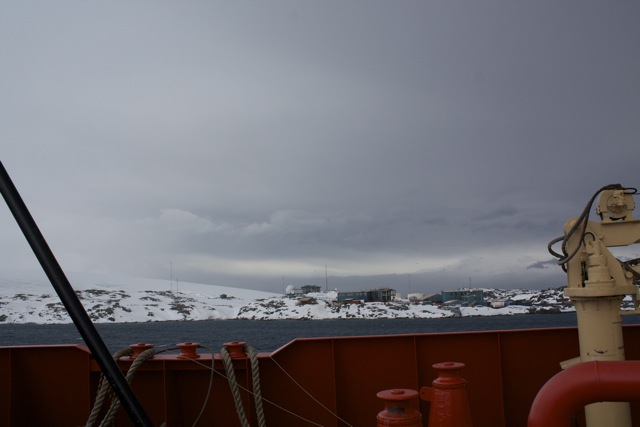
This is from a portal onboard the LMG.  The pier has the orange & blue storage containers 
that are called Milvans. 
This is the ship before it gets tied up.  (summer shot from the station)
This was taken on looking out at the Bow line handlers, there are two bollards that 3 lines get tied up to.  Each line gets handled one at a time and is handled systematically.
Different angle of the Bow line handlers
Later on in the season when you can see the rocks after the snow melt.  It is tricky to hoist the heavy lines over the rocks and snow to tie up.
This is definitely later in the season when the weather is nicest.  Whoever is a line handler must wear a float coat in case they fall into the drink. 
This is the Stern handler bollard position.  
This group hangs out at the midships bollard line.
Gould tied up and at rest.


Sunday, December 19, 2010

September 2010 - Headed back to Palmer Station

Update from Palmer Station: 
After a wonderful summer of Montana exploration, Art retreats and an Artist in Residence in Minnesota at Beaver Creek Valley State Park, I get to return to the home away from home and head "South" for the Minnesota winter.
I left home mid September and arrived 6 days later in Punta Arenas, Chile getting ready to take the "Laurence M. Gould" on a 4 day crossing of the infamous Drake passage crossing from the convergence of the southern Pacific, Atlantic and the northern Antarctic oceans can cause dramatic adventures inside a boat with turbulent seas. 
This is a statue of Bernard O'Higgins who was one of the commanders who helped free Chile from Spanish rule in the early 18th century; surrounded by the sculptured Cypress trees.
 Laurence M. Gould tied up at the Punta Arenas pier.
 There is a new Hotel in town called "Dreams".  They have a pool overlooking the pier which is glass enclosed on all sides, which I had the opportunity to visit, swim and enjoy the sun.  The big orange ship we'll take you can see in the background. 
As we were getting ready to "sail" the crew was doing last minute touch up painting while the weather was nice, as the sun you don't take for granted in this part of the world.
We are finally at sea and have been for 2 days.  The sun shining, the Drake treating us gently for our passage south.  
This is a view from the Bridge deck overlooking the bow out towards the rolling horizon.  If you look, you can see my shadow as I shoot.
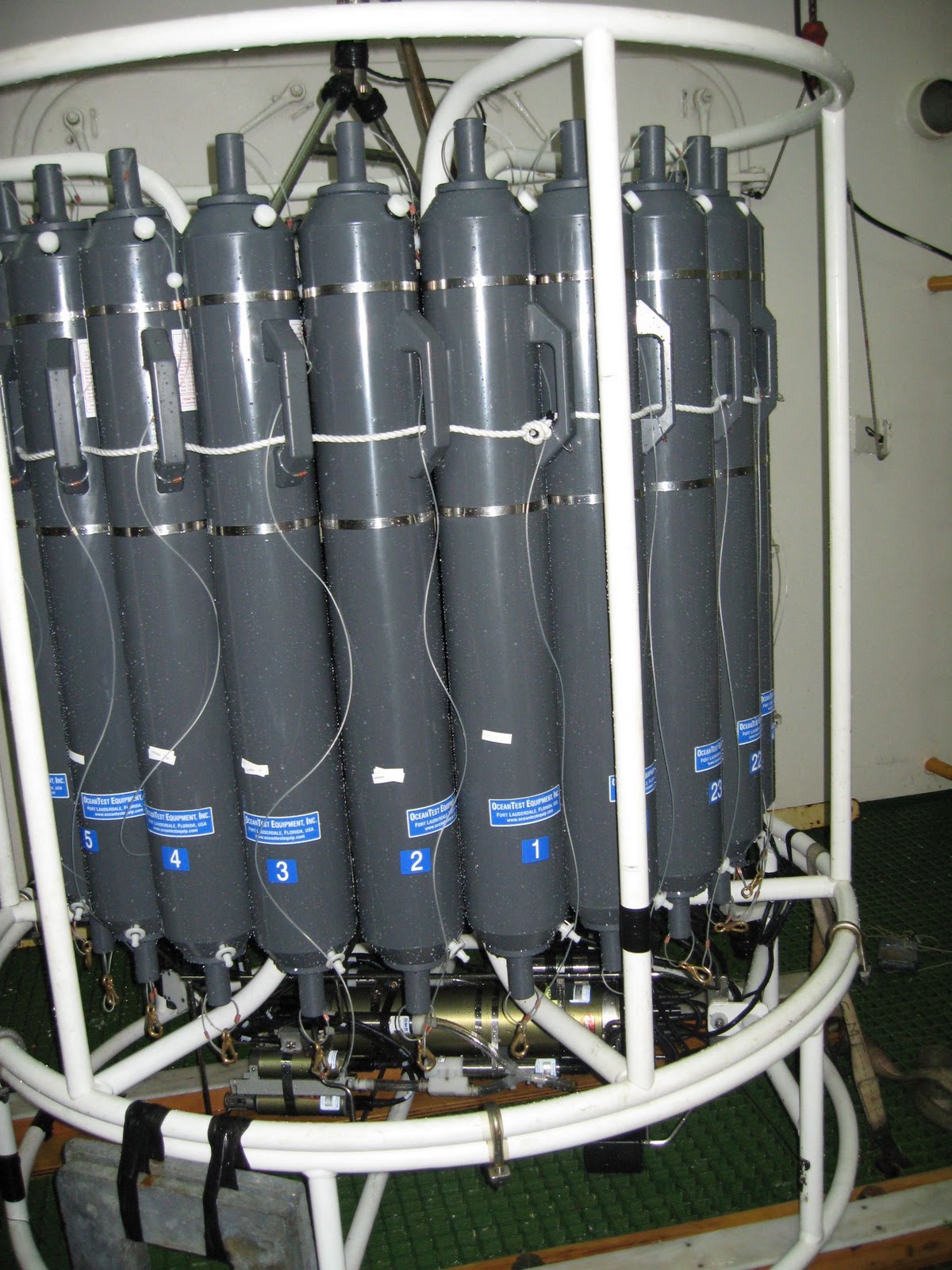
 Science happens the whole trip, looking out over the side of the ship, I look down and see they are launching a CTD rosette.
The CTD is an electronically controlled instrument used by scientists all over the world.  It stands for Conductivity, Temperature & Depth. The water is collected in these bottles called Niskins that get triggered to open at different depths to collect water samples.  
 The Rosette is extended out from the ship and lowered into the amazingly calm ocean.  
 As it makes it's decent into the oceans' depth, the bottles get triggered to open at Depth to collect water as it records salinity(Conductivity) and the Temperature gets recorded electronically.  
Samples collected are then methodically labelled and stored till it can be sent back to the lab for study.  
Eventually we enter icy slush that turns quickly into pancake ice as the temperature plummets.   
 We're heading through the ice field, slowly, deliberate and thankful for the calm seas.
The day passes with the sun setting on the ice and we get ready to arrive at Palmer.
 When we arrived just off shore of Palmer Station, the winds were too high for us to tie up, so we waited in Arthur Harbor for a couple hours and waited until the wind died down
Palmer is fully snow covered when we arrive.  Now to start our season...

Sunday, March 14, 2010

March 13th Sheathbill chick update and special visitors


Wow, is all I can say for my next installment...I have met some fun people, seen some interesting boats and our little chick is growing up. 

On Friday we had a unique ship visit us.  It was a "Tall Ship".  They are the larger traditional sailing ships with sails and lots of them. 
The ship that came to visit us is called the
"BARK EUROPA"
It hails from the Netherlands.  It was built in 1911 in Hamburg and it's original use was as a lightship.  A lightship is a ship that is moored in a dangerous area with warning lights to warn other ships to stay clear of the area.  The name at the time was "Senator Brockes" and was made of steel.  It was converted in 1986 to a three masted sailing vessel.  We were able to visit the ship and go on a tour.  I was one of a small handfull who wanted to see the engine room.  The room was so small you had to hunch to move around.  I don't know how they were able to do any work on the engines.  it was pretty tight quarters. 
Here the Ship comes around Bonaporte point that is a little peninsula opposite the station.

Then below is it rounding the iceberg that is sitting in our harbor.

and lastly is what the ship looks like when it is under full sail.  Pretty unbelievable.
here are some of the ropes to handle all those riggings...


Now let's go on to our little Lesser Sheathbill chick.  As you have read in the last post, we have a Sheathbill chick and it was so small and unique looking it was small about the size of a softball.  It's grown out of it's dark feathers and is now putting on a coat of it's more natural white feathers, save for his head.  The little one looks like a mini vulture.  I'd say he's about a couple inches bigger than a softball now, and whoa....fluffy!

The family lives underneath some rocks next to one of our buildings, but far enough away to give the family some privacy.  The parents have flown off one at a time to find food for the chick.  The Sheathbill is an omnivore which means it eats both vegetation and animal matter.  Which is what we humans are also known as.  Except the Sheathbills also feed on excrement (poo) which humans usually do not. 
The chick will fledge (lose all it's down) after about 50-60 days after it's hatched. I hope to have pictures of it after it fledges, but it's all about timing. 
Here's a picture of one of the parents...

So one of our other exciting news was that we've been visited by another Astronaut.  Buzz Aldrin and his wife visited station and we were able to get a group photo.
He gave a talk on board the National Geographic Explorer and a few people from station were able to go listen to him speak.  I was able to go listen to Neil Armstrong when he came so I stayed behind this time.  Both of these astronauts were the first people to walk on the moon.  How cool is that?

Our next big visitor was just as special.  He's known to many probably more well known than Neil Armstrong and Buzz Aldrin.
Bill Gates of the Bill & Melinda Gates Foundation came to visit along with some members of his family.  He talks a little about his visit in his blog.  http://www.thegatesnotes.com/Important-Trips/article.aspx?ID=116

We were able to get a group photo with him, but it's not available at this time. So instead here's a not so recent picture we have of him here at station.


Even though it's not recent, but we like it because we're a microsoft user here at station and he did have something to do with computers in the world. 

Palmer Station is almost at the end of the world, but we still get visited by many many special people, which in turn means we're in a very special part of the world. 

Sunday, February 21, 2010

Feburary 21 - more whales, Sheathbill chick, birding assistant and the Krill.

There was an interesting event that happened on the 20th.  There was a low tide and we noticed a ton of birds feeding on something by the waterline and then all these seals feeding also.  We investigated and saw Krill all over the place.  The Krill as you know is what is the one of the main foods for the whales and seals and birds here at Palmer.

Here's a picture of a Fur seal that had been feeding on the krill and a closeup of his face.  He has such cute ears and was just rubbing around on the rocks and was totally aware of my presence, but didn't seem offended.

This is a little krill in a tablespoon so you can get an idea of it's size.  This seems to be about a 5 year old krill.  I'm not an expert, but I have observed enough krill to get an idea watching science in the aquarium here on station.

We had the delight of finding a Sheathbill nest.  They nest under rocks usually and have been known to nest under buildings.  We've not seen a Sheathbill chick here as long as I have been coming to Palmer Station.  That's been 10 years.  Here's a picture of a Sheathbill parent watching out for it's chick.  This was a sunny day and they had come out of the next to absorb some much needed sun. 
Here's a closeup of the Sheathbill chick.  A little fluff ball about 8 inches tall.  After we discovered the sheathbill nest, we noticed Skuas hanging out around the next.  We're been keeping away from the nest hopefully to not disturb the already tense situation.  The Skuas would love little sheathbill chicks for a snack.

I was able to go out and help with Adelie penguin Fledgling counting.  We start out planning on a full day out on the islands.  We'll be counting, measureing beak and wing lengths, weight and general condition fo the penguins that are almost done fledging.  What that is, is when the little gray Adelie chicks start to lose their down and start into their teenage years.  The Fledglings hang out by the waters' edge until they fully molt.  Then they get to go out and explore the water.  They generally won't go out until they have fully lost their down.  Here's a picture of the first phase, the Birders Jen and Kirstie are counting the penguins.
After counting, us helpers hold out bamboo flags to keep the Adelie fledglings coraled.  Then the Birders go into the group and gently pluck one Adelie at a time to do measurements.  We do our best to keep our distance.  The flags on the end of the poles are enough of a deterant to keep them in a group.
Here I am getting to hold an Adelie penguin.  If you notice he has a tuft of feathers on top of his head. It always seems that this always makes them look like they have mohawks.
On our checking out the island, we also check out the Giant Petrels.  There is the Humble Island loop that takes us to all the Petrel nests.  We do the same more or less of counting the nests, weighing the birds and checking for any missing birds. 
This is Jen one of the Birders holding the Giant Petrel Chick to take measurements.  The birds as we, are gentle in handling so there isn't any tramatizing the birds. 
I'm gently holding a big warm fuzball of a Giant petrel chick.  They are big, but don't weigh as big as they look.  It's all fluffy feathers that make them look so big. 
Here we are getting ready to travel to another island to check on more birds.
Here we are traveling between Islands.  I think we hit three different islands this day.  Total count of Adelie's was 96.


These pictures are taken from station when the Humpbacks stopped by while there were Krill in the area.  This is a good picture of the inside of the roof of the mouth of a Humpback.  I heard but can't confirm it yet, that this has something to do with cooling of the whale.  This will take some more research.
 
Here's a group from station in their zodiac checking out the Humpback whales.
This is the Birders watching from a safe distance the whales feeding and checking out the behavior of the birds.